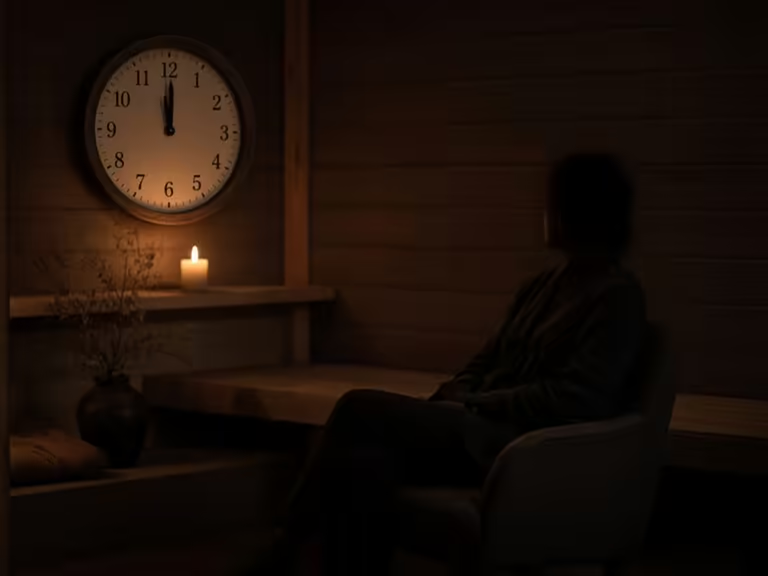
This picture is a fitting image of the hurricane of thoughts some participants have in their heads 🙂
As you can read in the accounts of people’s experiences in the dark, there are participants whose thoughts become more intense, and others for whom that doesn’t happen at all – they spend the whole week enjoying themselves as if they were on cloud nine.
What kind of participant are you on a dark retreat?
Broadly speaking, some people are more logical and some are more feeling-oriented. Logic is more masculine energy (yang), while feelings are more feminine energy (yin). This has nothing to do with gender, but with which side of your life energy you use.
In essence it doesn’t matter whether you perceive the waves of energy in your body more as thoughts or more as feelings, so we believe you will recognise yourself in some of the following situations.
Waves during a dark retreat
Let’s assume a participant intends to stay on a dark retreat for a whole week, from Saturday to Saturday. What might go through their head? On arrival we basically tell everyone that the mind (those voices in your head) will do anything to get you out of the dark. So the participant may experience the following situations.
“I’ve already got everything I came for, so I can go home on Wednesday.”
A very common thought, which usually means that something is being uncovered inside the participant that the mind doesn’t want to see. Our recommendation: LSoS.
“Where is this feeling coming from?”
A typical manoeuvre of the mind: looking for a cause and thereby diverting attention from the feeling that is happening right now (the present). Our recommendation: LSoS.
“What am I even doing here?”
Questioning your own decision helps the mind divert attention from the present and steers you into the past, endlessly going over your own decisions. Our recommendation: LSoS.
“I’ll go home on Tuesday, because I’m taking a place from someone who needs it more.”
Comparing your life situation with other people’s is a favourite technique of the mind to divert your attention from the present so that you deal with how others are doing instead. Our recommendation: LSoS.
“Nothing’s happening, I can go home on Thursday.”
Everyone’s mind creates expectations, whether they are aware of it or not. Comparing the life situation that is happening right now with a picture of expectations painted in advance serves to diminish the actual experience. Our recommendation: LSoS.
“What time is it?”
My usual question-answer, “If you need to know the current time for your further spiritual development, I’ll tell you”, usually works, and the participant bursts out laughing. Our recommendation: LSoS.
“I have a feeling they need me at home.”
Fear is the mind’s ace up its sleeve, and it usually works to divert attention from the present to your family, loved ones or friends. Our recommendation: LSoS.
“I’ve got a lot of work to do at home.”
Some people experience a dark retreat as idleness, when they could actually be active as usual, and feel they are wasting time in the dark. Our recommendation: LSoS.
“I’ve got a lot of work to do at home.”
Some people experience a dark retreat as idleness, when they can’t be active as usual, and feel they are wasting time in the dark. During a dark retreat the body has time to work on itself, sometimes imperceptibly. Our recommendation: LSoS.
“It’s too cold/hot in the sanctuary.”
“There’s too much dust in the sanctuary.”
“There’s too much/too little space in the sanctuary.”
“The mattress in the sanctuary is too soft/too hard.”
“…”
We could go on like this for hours. It’s natural: the mind will find anything at all and then keep going over it again and again to draw your attention away from the present moment. Our recommendation: LSoS.
Perhaps you are now wondering what LSoS stands for.
Leave the Sanctuary on Saturday … in other words, enjoy the whole week in the dark 🙂