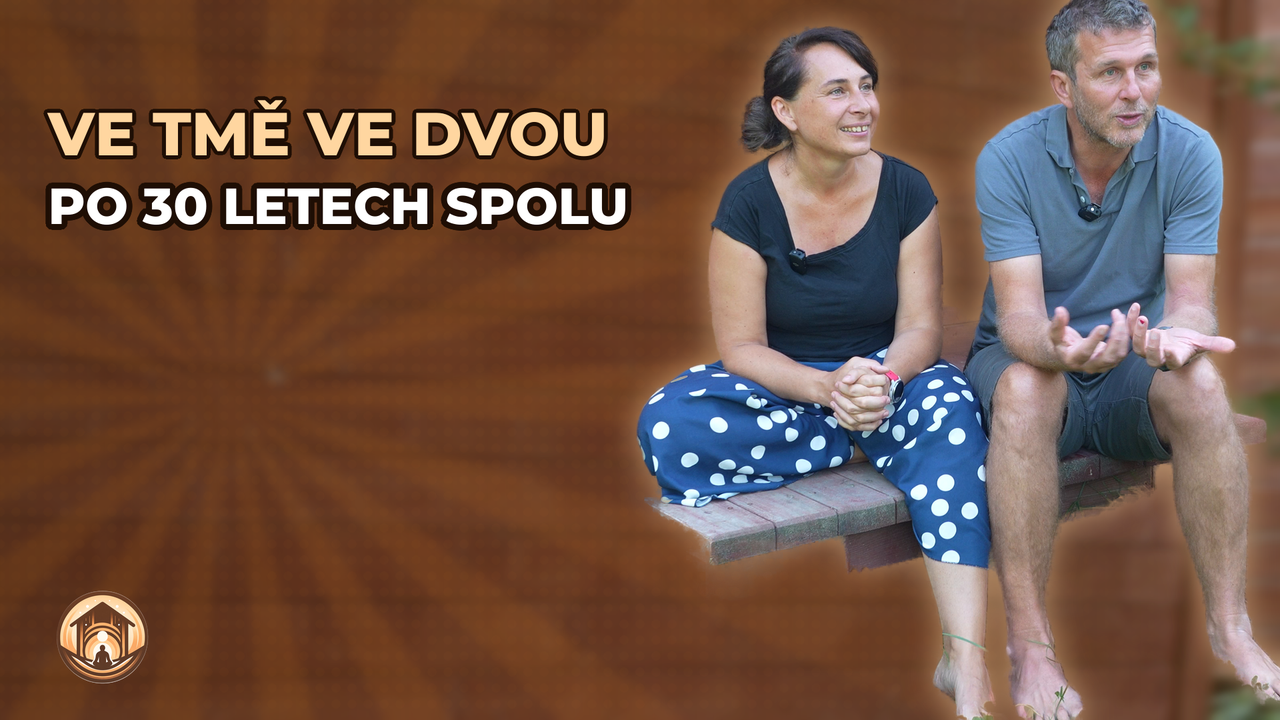
A dark retreat doesn’t have to be about solitude. This time we bring you the experience of a married couple who have been together for thirty years and have three children. They went into the dark together for the first time and spent three nights in one cabin. Why didn’t they each go separately, how do you talk about difficult things in the dark, and what do they think such a conversation should begin with?
Darkness as another shared experiment
Right now we’re going through a phase of our relationship where we experiment and do all sorts of things together. The dark was simply one of the activities we wanted to try as a couple. We explore our inner worlds in various ways; over the last year or two we’ve been examining ourselves and our relationship a lot, and we go to therapy, both individual and couples.
After coming out of the dark we spent four hours sharing our experiences with the other participants. We talked about what each of us had been through, and it was terribly interesting.
A dark retreat: she wouldn’t have gone alone, he originally wanted to
She: It was probably my husband who wanted the dark more. And perhaps it partly came from the fact that I probably wouldn’t have gone on my own. So we thought we’d go together, because that’s something different again from being there alone.
He: Originally I wanted to go alone; I’d been thinking about it for quite a while. Then it occurred to me that it could be a shared experience. I realise it’s different from being alone, and I’m probably still planning to go on my own too. But this we wanted to try together, to see what it would be like.
I think you can turn inward even as a couple. When we lay there together for a while without talking, for instance, you could experience part of the darkness just with yourself. If we’d been here for more days, we might even have divided it up and agreed not to communicate with each other for a certain time. In the dark you’re sort of separate. You do have an anchor, it’s different from being completely alone, but you can simulate it a little.
Three nights flew by
We chose the shorter version, three nights. It felt very much like any ordinary evening and it went by very quickly. She: I was afraid it would feel long, but it flew by.
If we went for a week, we’d probably each go on our own. I don’t know whether anything else would happen as a couple. We felt terribly normal and natural there; it was similar to being at home. We’re wired for thinking and talking, so what people usually practise here in the dark is what we practise all the time, every day. We talk a lot with each other and we’ve already worked through plenty of things in normal life. So we don’t really lack a quiet time when we can tell each other things.
After thirty years together, a moment of coming closer
We’ve been together for thirty years and have three children. But when we think of certain phases of our relationship when we didn’t have time for each other or were more distant, the dark could be a very interesting moment of coming closer. I think that could be really interesting.
Darkness therapy and a conversation without facial expressions
What was interesting was that you can’t see the other person and you can’t see their facial expressions. So perhaps you can open up more, talk more, and you don’t get instantly wound up by the non-verbal communication you’re used to. And yet you can hold their hand. It’s a slightly different kind of talking.
In the dark you concentrate more on yourself. When a couple is discussing something, it’s important to keep an eye on your own emotions too, so they don’t fly off somewhere, and in the dark that’s easier to do. In a face-to-face conversation a more sensitive topic or some disagreement can escalate more quickly. In the dark, a calm conversation about something more complicated can last longer. That’s what we were trying out.
We can’t walk out, and that keeps the discussion calm
He: Beforehand I was a little worried that we’d be shut in one room and wouldn’t be able to leave. Often, when we’re sorting something out, one of us leaves the room or goes off somewhere to cool down. Paradoxically, though, it keeps the discussion civil. When you know you can’t go anywhere, you keep a closer watch on your emotions.
We didn’t get quite that close to it, but I can imagine that you watch your emotions more when you know you’re in one space with the other person.
Advice for couples: start with something positive
She: In the dark I remembered that when we’d been kept apart by various obligations and then were suddenly together again, there was always a bit of an interval before you tuned back in to the other person. This time it wasn’t really needed, but I think it works quite well in the dark.
I’d recommend that people first say something positive to each other. That tunes you in to one another, it brings a kind of positive mood into the space, and then things can go well.
My brain filled in a washbasin
He: The cabin itself and the technical side were absolutely superb as far as I’m concerned, nothing to fault. The food, the ventilation, the water and everything around it, all done perfectly.
I found it terribly interesting how the brain fills things in. I had a feeling there was a washbasin there, and suddenly at moments I could see it, even in a completely different place from where it really was. The visual hallucinations are there, and it’s interesting to give them your attention and watch them.
It’s definitely an interesting experience and we recommend that everyone gives it a try.
We’ve put together the most frequently asked questions that clients ask themselves before deciding on darkness therapy.
Follow our YouTube channel too, where you’ll find videos about the retreats and people’s experiences with darkness therapy. 🔔